
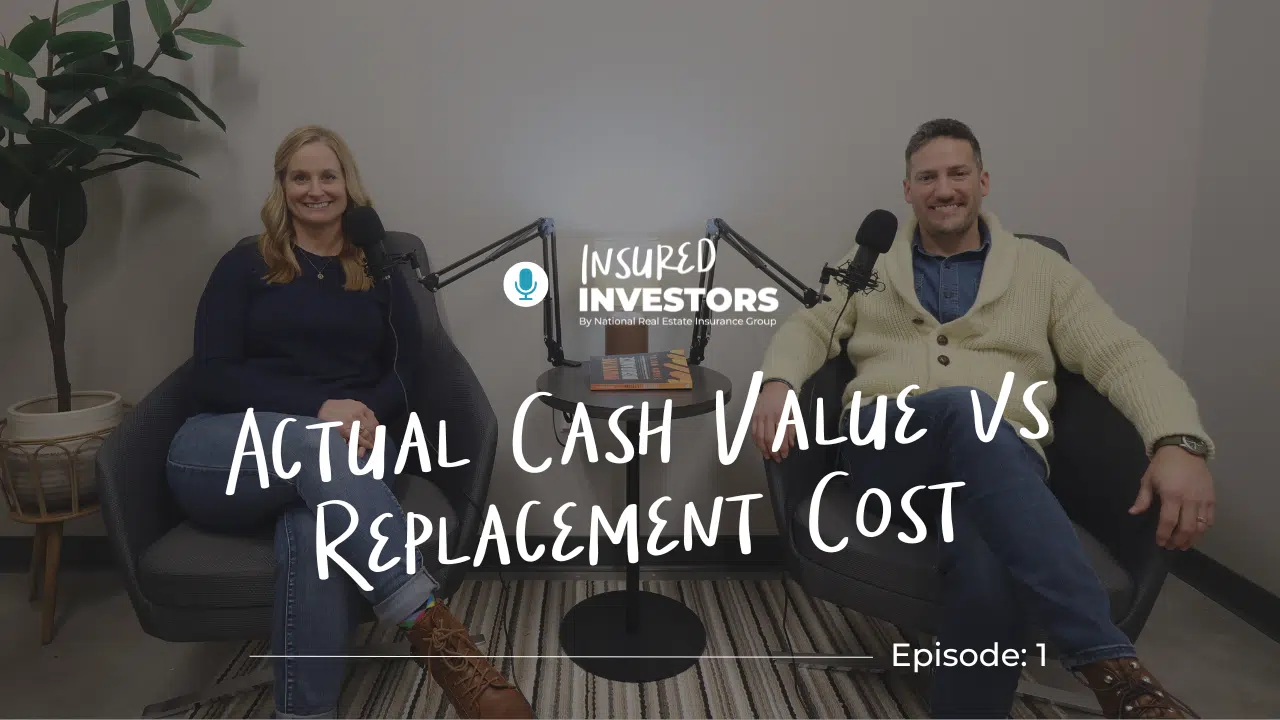
Welcome to our first episode of Insured Investors. Today, we are discussing loss settlement methods. Choosing between Actual Cash Value and Replacement Cost provides a lot of confusion for investors, especially when it comes to how their claims will be paid out in the instance of a loss.
So, we brought in an insurance claims expert, Zach Baker. Zach is the Director of Client Experience at National Real Estate Insurance Group. He heads the team that acts as a liaison between the client and the insurance carrier during the claims process. Zach started in the insurance industry 18 years ago as a claims intern in college. Here, he found the industry’s stability and ability to help people appealing and never looked back.
How are claim payouts determined?
When you file a claim with your insurance company, they’re going to figure out how much they owe you for the damages. The insurance company is first going to send an adjuster out to inspect the property. Then, the inspector is going to write an estimate for the damages. How much you are paid depends on your deductible and the predetermined loss settlement method that you’ve selected for your policy.
We (NREIG) are the liaison with the insurance companies themselves. They’re the ones who will hire the adjusters and approve or deny claims. We’re happy to help facilitate conversations; however, we don’t inspect, approve, or pay the actual claims.
What is a loss settlement method?
It’s the insurance company’s method of determining how much you’re going to get paid after a loss. In property insurance, generally, it’s one of two options – Actual Cash Value (ACV) or Replacement Cost (RC).
And the difference between those two is just how they handle depreciation. The reason you have depreciation involved is that property insurance, unlike auto insurance, doesn’t have a market for used building materials. Property insurance is designed to pay you for what the property is worth. Because you can’t buy used drywall, the insurance companies must start with how much new drywall costs. Then, they make a deduction based on how old the drywall currently is to determine the Actual Cash Value.
What’s the difference between Actual Cash Value and Replacement Cost?
It’s all about how depreciation is handled. With Actual Cash Value, you’re going to be paid for what the property is worth. And then, that’s the end of the settlement for you. But with Replacement cost, the depreciation can be recovered depending on how much you spend on the repairs.
A good example to think through is if you have a partial loss, let’s say a kitchen fire. The adjuster comes out and they write an estimate for the damages, and they say it’s $30,000 to fix. If $15,000 of depreciation is assessed, the kitchen has used half of its useful life. If you have Actual Cash Value and you have a $3000 deductible, your settlement will be $12,000. So, you’ve got the $15,000 Actual Cash Value minus your $3000 deductible. That’s why you get paid $12,000 and that’s it for your claim.
Now, what you do with that money is up to you. If you want to do the repairs, you can. If you want to use the money for other things or sell the property, you have those options too. Keep in mind if you don’t do the repairs and have damage to the kitchen in the future, the insurance company is not going to pay for the same damage twice. In other words, if they paid for it once and you don’t do the work, they’re not going to include that in any future claims. But technically, you can use the money for whatever you want.
If you do the repairs AND if you have Replacement Cost coverage and say the kitchen repairs end up costing you $20,000, the $5000 spent above the Actual Cash Value settlement could be recoverable from the insurance company. Your total payout would be $17,000. So, it’d be the $20,000 ($15,000 ACV plus $5000 in extra repair cost) minus your $3000 deductible. You must pay the deductible regardless. But your settlement could be $17,000 total.
Overall, it is about depreciation. It’s getting assessed at the beginning no matter what. And it is a matter of if you have Replacement Cost, you can recover that depreciation. But if you do the repairs and if you have Actual Cash Value, you don’t recover the depreciation. That means you have to pay out of pocket the additional repair costs.
As an investor, how do I know which one to select?
There are a lot of things to consider. One, and probably the biggest one, is if you imagine the worst-case scenario and the whole building burns down. What would you do with the property? Would you fix it up? Then, Replacement Cost might be a good option. If you would just clean the land and sell it or do nothing with it, then Replacement cost might not be a good choice. Because you have to do the repairs to realize the depreciation recovery. If you never intend to do the repairs, it doesn’t make a lot of sense to spend the extra money on Replacement Cost coverage. The cost is roughly 20 to 25% more on your premiums for Replacement Cost than Actual Cash Value. There is a higher cost with RC because the insurance company is going to pay more after a loss.
Beyond what you would do with the repairs after a total loss, think through your financial picture and appetite for risk. As with anything, you’re trading a known risk, which is your premium payments, for an unknown risk of a property loss. It’s the classic insurance trade. You’re trying to figure out what’s known and what’s unknown. One thing to think about is that, unlike some other trades you have in insurance, the tradeoff for potential risk when it comes to depreciation is not static – it’s not staying the same. Every year that goes by, the property is getting older. Therefore, your depreciation percentage is getting higher. We’ve also seen the cost of repairs and construction materials go up astronomically in the last few years. The higher and more expensive things are to repair, the more your depreciation exposure is. So, what you’re trying to decide is how comfortable you are self-insuring the depreciation. When we have the property getting older and the cost of goods going up every year, those compound on each other and can make your exposure to depreciation quite substantial over time. For this one, it’s a factor of your comfort with self-insurance of depreciation.
There’s another big one. Does your lender require it? If your lender requires Replacement Cost, then you don’t have a choice. That’s the route you’re going.
But if you do have a choice, those are some of the things you want to think about.
As an investor, I’m thinking about my overall business strategy and model. How does the number of locations and their age impact the coverage that investors are selecting?
If you have a lot of relatively new locations or remodels that have happened recently, your depreciation exposure is going to be lower than if you have significantly older properties. So, investors may choose ACV. Because again, the older they are, the more depreciation is going to be assessed.
You said that Replacement Cost is potentially 20 to 25% more than Actual Cash Value. But what does that breakdown look like? How am I paying for Actual Cash Value versus Replacement Cost?
Most insurance companies may do it a little bit differently than we do in our program. They have an endorsement you would pay for, giving you Replacement Cost coverage on your policy. In our program, you are going to select a higher total insurable value to get the Replacement Cost coverage. So, the amount of money that you will pay per square foot is going to be more for Replacement Cost than if you’re going to stick with Actual Cash Value. Again, it’s roughly 20 to 25% more expensive for the properties in our program to hit the threshold to get Replacement Cost. So, it’s set up a little bit differently than what most people may be used to. But you’re getting more value because you’re getting a higher total insured limit for your property should you have a total loss. It’s not just replacement cost, you’re accomplishing a couple of things at once. That’s how we do it in our program.
Is there anything else real estate investors should consider when choosing a loss settlement method, other than what we’ve already talked about?
I think the biggest one, again, is just what’s their appetite for the unknown and self-insuring portions of the claim or portions of the loss of a property. You got the fact that depreciation is not static and from just that alone most people will decide they’re either comfortable with uncertainty or they’re not. And if they’re not comfortable with uncertainty, then going to Replacement Cost might be the best route. Then you know you’re going to settle at what it costs to do the repairs.
If you’re more comfortable with uncertainty and you’re willing to roll in that direction, then Actual Cash Value can be a good option. Again, it’s cheaper so you can save some money. There is a balance between the money you would save on your insurance premium versus the potential out-of-pocket costs for repairs. But it can save you money if you are comfortable with that risk.
Another thing to consider is are you handy yourself? There are some things I could do at my house, and I wouldn’t necessarily have to hire out. I might be able to do the repairs for the cost of the ACV settlement. Or, if you have a contractor who can do the work for a lower cost, then you may not need Replacement Cost coverage because then you’re paying for something where you won’t ever realize the benefit. Everyone’s situation is different. The relationships are different. Their skills are different. So, it depends on the mix of those factors and which direction makes the most sense for them.
I think, as with anything insurance, it feels like it’s a complicated topic. But when you boil it down, the different loss methods are just about the depreciation and what happens to it. Actual Cash Value, you don’t recover depreciation. You get paid what everything is worth on the day that it’s damaged. That means you might have to pay some out-of-pocket for repairs.
Replacement Cost coverage means you get paid up to what you spend for the repairs. The insurance company will pay for new materials and new repairs. There’s more coverage and that’s why it’s more expensive.
It’s all about what you want out of the insurance policy, your priorities, and comfort with risk. At the end of the day, with Actual Cash Value and Replacement cost, the only difference is whether the depreciation is recoverable. It’s not recoverable with ACV and it is with RC.
Watch or listen to the full interview here!