
You may be surprised to learn that your definition of flood and your insurance company’s definition may differ. And we get it. It’s a confusing topic, especially for those not in the insurance industry. But understanding the differences between flood, water damage, and sewer backup may help determine what type of insurance you need for your property and may even save your business.
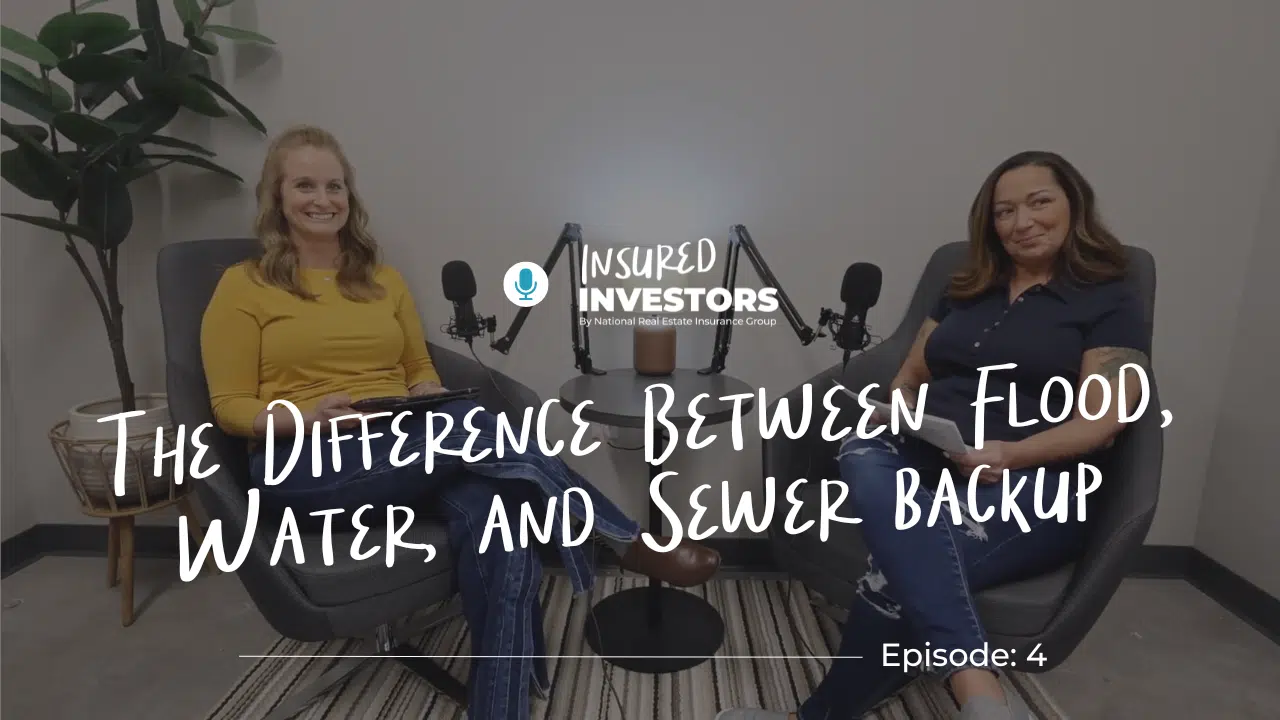
So today, we brought Denise Laakmann, Sales Advisor at National Real Estate Insurance Group. Her job is to educate investors on the differences in insurance coverage and assist them in determining the best solution for their business model. Denise found her way into the insurance industry at a military event when a local insurance agency mentioned they were hiring. She applied, got the job, and 10 days later passed her licensing exam. And the rest is history. Denise is the chapter secretary at the Kansas City CPCU (Chartered Property Casualty Underwriter) Society and is currently earning her CPCU designation. She served in the military for eight years, has a major in music education, and can play the trumpet and French horn.
What is considered a flood?
Flood occurs when water from natural sources, whether it be a river, a bank, a lake, or whatever the case may be, breaches the banks. An example is heavy rains that over-saturate the grounds with the water and cause it to seep into the foundation of a property. It’s coming from external water sources.
Do most property policies cover flood damage?
No. It is a separate coverage. It’s usually excluded from the policy itself. So, if you want Flood coverage, you’re going to have to get a separate Flood policy.
Is this something that an insurance agent would generally tell you?
Probably not. They’re probably not going to say, “Hey, well, you know, this doesn’t include Flood and if you want it, then you got to add it.” It’s one of those things where if you don’t really bring it up, they aren’t going to say it’s excluded. You always have to watch for exclusions on your policies.
When should somebody consider buying Flood Insurance?
So if there’s a loan, a lot of times the lenders are going to require it depending on where the property is. If the property is in a flood zone, consider purchasing Flood coverage (if your lender doesn’t require it already). You can go to the FEMA (Federal Emergency Management Agency) website and see what flood zones you’re in and check the high-risk flood areas.
What are the different options when buying Flood coverage?
There is an NFIP (National Flood Insurance Program) flood program, which is through the government. It is administered by the Federal Emergency Management Agency and sold through a network of other insurance companies, or you can also do it through them directly. But with the NFIP, there is a 30-day waiting period. Sometimes, if your loan requires Flood coverage, they may be able to waive that waiting period.
We, at NREIG, have our own Flood program as well. What’s nice about our program is there is no waiting period. So, if you need that coverage now, we’re going to get you that coverage.
Now how much does Flood Insurance cost?
It’s not cheap. You’re probably going to annually pay about $700. That’s a basic Flood policy, but it depends on the flood zone, the type of house, and where it’s at. There are several factors that kind of play into how much that coverage would be.
Would the cost also depend on geography?
Yes, absolutely. If you’re living in the middle of the United States, you’re not looking at high flood zones. But down in Florida, where part of your property is pretty much in the water, there’s a particularly good chance you’re going to have a flood.
What is considered water damage and why do people confuse it with flood?
It’s one of those things where you must think of the source of the water. Most people think there is a leak in the basement, so their basement is flooded. Technically, that’s not flood damage, it is water damage. With water damage, it is a sudden and accidental discharge or overflow of water. For example, a pipe burst or an accidental overflow of the bathtub. Flood is from an external source and water is from an internal source.
How would someone go about getting water damage coverage?
Water Damage is a common policy exclusion. If you want to make sure you have this coverage the best thing to do is, ask your agent. You also want to look for Special Form coverage, which is the most comprehensive form of coverage that you can have.
And, if anyone missed it, we have an episode that covers Basic and Special Forms.
Another item that often gets confused with water damage and flood is sewer and drain backup. Can you tell us what that is and how to get coverage for it?
Coverage for this is usually through an ancillary product that you can add to your policy. Sewer and drain backup is when water backs up or overflows from the sewers, the drains, or the sump pump. This could happen during heavy rains or a kid clogging the toilet with a toy. Again, people may refer to this as a flooded basement, but it’s not. It all depends on how the water enters the dwelling. So, if it seeps in from the outside, you’re looking at flood damage. With internal sources, you are looking at either water damage or sewer and drain backup.
NREIG offers coverage for sewer and drain backup through our Tenant Protector Plan, an ancillary product. This product also offers other coverages. However, Sewer Backup is oftentimes its own coverage and deductible limits.
Let’s recap. How do these coverages differ?
Flood coverage is normally excluded from your policy. You want to make sure that if you need this coverage you ask for it. A flood is when the water is coming from external sources into the property itself. So, when there’s heavy rain or the ground is over-saturated water and water is seeping into the property.
Water damage is sudden and accidental and from an internal source, like when a pipe bursts or a bathtub overflows. This can be purchased through Special Form coverage.
Sewer and drain backup is when water backs up and overflows from a sewer drain. Heavy rains could be forcing the pipes to push the water back up into the property. This is almost always excluded from policies but can be bought back.
— Game Segment: Fact or Fiction —
We’re going to play a little game of Fact or Fiction regarding floods, flooding, Flood coverage, all of that.
Fact or fiction? To get Flood insurance, you must live in a floodplain.
This is fiction. Anyone can purchase Flood insurance. In fact, 40% of NFIP insurance claims happen outside of a high-risk flood zone area. You don’t have to be in a flood zone to purchase Flood coverage. But obviously, you don’t want to pay for something you don’t need. So, it’s good to at least look into it.
Fact or Fiction? Flood maps don’t change.
Again, this is fiction. Flood plains and maps evolve. They’re constantly changing. Just because you weren’t in a flood zone 20 years ago, there is a chance you could be now.
Fact or fiction? During a 30-year mortgage, you’re 27 times more likely to experience a flood rather than a fire.
Fact. Floods are really the most common and most expensive form of natural disaster in the U.S.
Fact or fiction? One inch of water can cause $25,000 of damage to your property.
Such a fact. Even the smallest amount of water can really rack up the cost. It can be an extremely expensive thing to fix. A lot of people don’t want to pay this extra money for Flood coverage, but when a flood occurs, they are thankful they did.
Watch or listen to the full interview here!