
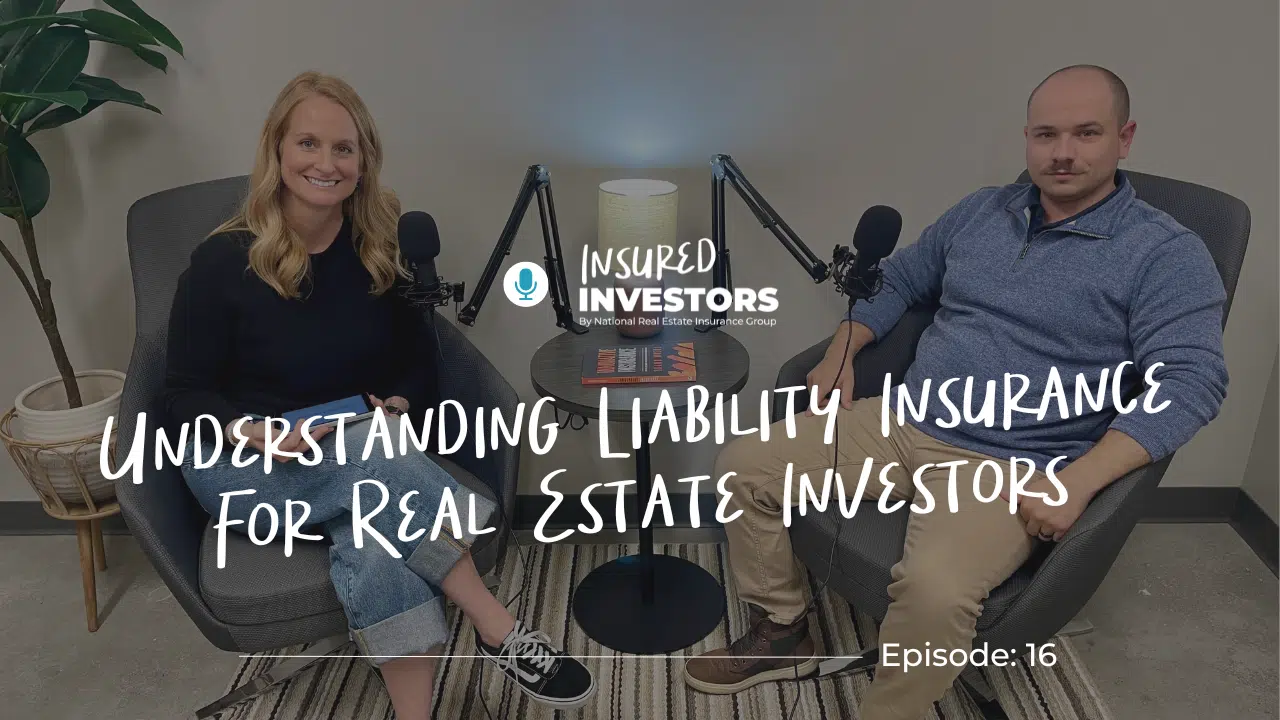
Welcome to today’s episode where we’re diving into a crucial, yet often overlooked topic for real estate investors, liability insurance. As a real estate investor, protecting yourself from potential risks and legal claims is key to safeguarding your business’s future.
In this episode, return guest, Casey Carter is sharing why liability coverage is vital and the types of liability coverage you should consider to ensure you’re fully protected.
What is liability coverage?
When investors are purchasing insurance, they may see multiple different lines of coverage. One line of coverage is liability, which protects you financially from being sued for someone else’s injuries or property damage. There are multiple types of liability, but it is, in fact, one of the most important coverages you can obtain. In many cases, property damage costs are minimal compared to liability claims. Everyone knows how expensive lawsuits can be. And liability coverage is what’s protecting your finances.
Why is it so important for investors to have liability insurance?
I think the biggest importance is the out-of-pocket expenses. If someone is injured, or God forbid, dies on your property, you could be looking at a half-a-million to a million-dollar lawsuit. Slip and falls are common liability claims and those range between $10,000 to $50,000. Those aren’t small chunks of change and not everybody has that lying around. So, again, liability coverage is there to protect you financially.
Let’s talk about liability limits. What are those and can you tell us what per occurrence and per aggregate mean?
When you’re looking at your policy documents, you’re going to be looking to the right side of your certificate of insurance. You may see numbers like $500,000/$1,000,000 or $1,000,000/$2,000,000 and have no idea what those mean. Those are your limits. The first number is per occurrence, which is the amount that your policy will pay out at any given occurrence. So, if someone slips and falls that is one occurrence. At NREIG, everything we sell has a minimum of $1,000,000 per occurrence limit. So, at any given occurrence, you could receive up to $1,000,000.
Now, if someone slips and falls the next month, that’s when we get into aggregate limits. Multiple occurrences in a policy term can add up to your aggregate. For example, if you have two separate slip and fall accidents in a policy term, both those occurrences would add to your aggregate.
For investors who self-insure their property exposure, can they purchase liability coverage separately?
Absolutely. And more than anything, I would recommend that they have that premises liability. If you’re self-insuring your property and a loss occurs, you may need a new roof. That’s not as costly as someone getting hurt on your property. You may be able to recover from a $25,000 property loss, but not a lot of people are going to come back from a $1,000,000 lawsuit.
You mentioned premises liability, which is a type of liability coverage. Can you go over what premises liability covers?
Yes, premises liability is for expenses related to third-party individuals who were injured or had property damaged on the premises. It’s not for owner injuries or paid workers, like a contractor. (You’ll want to have a GC or artisan policy for that.) This is for an instance where someone is injured on the property, and you were found negligent because something could have been done to avoid that injury. That’s really what premises liability is. It covers the premises you own and does not extend outside of that particular location.
What are some other types of liability coverage that real estate investors may be interested in?
There are few. First, let’s say you’re a real estate investor and you’re acting as your own property manager. In this case, you could obtain professional liability, also called errors and omissions (E&O). It covers professional acts. So, if you are the property manager, any acts surrounding that could potentially be covered under professional liability. At National Real Estate Insurance Group, this coverage is called PMEO (Property Management Errors & Omissions) and can be purchased as an add-on. It’s one of the few programs that we have where you can buy into an aggregate limit.
Another liability coverage investors could find useful is Products and Completed Operations. This isn’t going to be covered under your premises liability, and it’s for exactly what it sounds like, products and completed operations at the location. Maybe you built the deck in the back of the property, and you sell the property. Twenty days after you sell it, the buyer walks on the deck, and it falls. That’s something you would want to make sure that you had products and completed operations for.
Lastly, investors may want personal and advertising injury. Again, it’s not included in a premises liability policy. It covers things like libel, slander, or invasion of privacy – non-physical injuries.
That’s something that’s also excluded in a premises liability policy. Maybe you said some things about a competitor that may or may not have been true and it damaged them financially. That’s where the personal and advertising injury comes into play.
What should investors consider when determining how much liability coverage they should purchase?
There are a lot of different points we could discuss, but I’ll highlight the most important, consider your risk exposure. Do you have a single-family residence where a mom, dad, and two kids are renting out a property from you? Or do we have a 20-unit apartment complex where we have 20 different families living at this location? Liability limits aren’t typically per unit but per location. And a 20-unit apartment carries a lot more risk exposure than a single-family home. So, for a 20-unit apartment, you may want to look into an excess liability or umbrella policy to provide more coverage.
You should also consider weather patterns. Is the property in the middle of the desert? Or is it in Montana, where they get a lot of ice and snow and it’s easy for someone to slip and fall on the property? That’s a couple of different things to consider when evaluating your risk exposure. The higher the risk, the more liability coverage you will want to have.
— Game Segment: Liability Loss Scenarios —
We’re going to share some lawsuit scenarios, and you’ll let us know if liability coverage would come into effect.
Scenario 1: A tenant or visitor slips on an icy sidewalk and sustains injury. They sue you for medical expenses and damages, claiming that you neglected property maintenance.
That is a situation that could potentially be covered if you were made aware of a dangerous situation and there were no steps taken to rectify it or make it a safe environment for people in that space. As an investor, it’s your responsibility to mitigate risks on the property. It all comes down to negligent behavior. Was it something that was completely out of anybody’s control or could you have made the situation better?
Scenario 2: A pipe bursts in your rental unit causing severe water damage to the tenant’s personal belongings. The tenant sues you for not maintaining the plumbing system properly.
In that case, unless the owner was made aware that there were issues prior to the storm, you’re going to see property coverage come into play for repairs. And for the tenant’s belongings, there should be a contents policy for that. Whether that is something they purchase on their own through renters insurance, or if you, the owner, purchased coverage through something like NRIEG’s Tenant Protector Plan. This scenario is why a lot of investors require their tenants to purchase renters insurance.
Scenario 3: A tenant claims that you improperly evicted them without following legal procedures and they sue you.
It depends on what coverage you actually have in place. If you only have property premises liability, unfortunately, this one’s not going to be on there. A professional liability policy would most likely help you in this case. It would just be very dependent upon what your policy language states.
This scenario brings up a good point in that there are more landlord-friendly states than others. In this instance, landlords really need to be aware of the laws in their cities and states when it comes to evicting people.
Scenario 4: You, a house flipper, replace the roof on the property yourself. After the home is sold, the new owners discover significant leaks due to improper installation leading to property damage.
If you’re doing that work yourself, you almost always want to have a Products and Completed Operations policy in place. This can’t always be the easiest to obtain for somebody doing work themselves, not on a professional basis. Fortunately, NREIG has a product called FlipShield that can assist with that, along with Personal and Advertising Injury. This product is a minute cost compared to a full-blown contractor or artisan policy to do that work yourself and have that coverage a year after the property is sold.
Watch the full interview here!